
HeyBuildersInc

empty

Smart home technology integration during home renovation

Why Los Angeles Homeowners Are Making Smart Home Integration a Renovation Priority If you’re planning a home renovation in Los Angeles in 2026, smart home technology isn’t a nice-to-have anymore — it’s expected. Affluent neighborhoods from Brentwood to Pacific Palisades are seeing homeowners embed intelligent systems directly into their renovation plans, creating homes that are more comfortable, energy-efficient, and secure from day one. Unlike aftermarket installations, integrating smart technology during a renovation lets your contractor run wiring, install recessed sensors, and position equipment behind walls where it belongs. The result is a seamless, clean look that matches the aesthetic standards of a luxury LA home. The Core Smart Home Systems Worth Investing In Lighting Control Systems: Whole-home lighting control from brands like Lutron Homeworks or Ketra goes far beyond dimmer switches. These systems let you program scenes for every room — morning routines, dinner parties, movie nights — and adjust automatically based on time of day or occupancy. During a renovation, your electrician can run the dedicated wiring these systems require, which is far more reliable than wireless alternatives. Climate and HVAC Zoning: Los Angeles weather is mild, but the difference between a sun-baked west-facing living room and a shaded north-side bedroom can be dramatic. Smart HVAC zoning with systems like Mitsubishi’s Kumo Cloud or Daikin One+ lets you control temperatures room by room. Pair this with motorized window treatments from Lutron or Hunter Douglas, and you reduce energy costs significantly while maintaining perfect comfort. Integrated Security and Access Control: Modern security goes beyond cameras. Systems from vendors like Control4 or Savant unify video surveillance, smart locks, motion detection, and intercom systems into a single interface. During renovation, your contractor can position cameras with optimal sight lines and run low-voltage cabling to every access point — something that’s difficult and expensive to retrofit later. Whole-Home Audio and Entertainment: Distributed audio systems like Sonance or Sonos Architectural let you enjoy music in every room without visible speakers. In-wall and in-ceiling speakers installed during construction deliver superior sound quality compared to standalone units. For dedicated home theaters, acoustic treatment and equipment placement should be part of the renovation plan from the start. How Much Does Smart Home Integration Cost in Los Angeles? Costs vary widely depending on scope, but here are realistic ranges for LA-area projects in 2026: Basic smart home package (lighting control, smart thermostat, doorbell camera, smart locks): $8,000 – $15,000 Mid-range integration (whole-home lighting, HVAC zoning, security system, distributed audio in 4-6 rooms): $25,000 – $60,000 Full luxury integration (enterprise-grade lighting, motorized shades throughout, dedicated home theater, complete security, networking infrastructure): $80,000 – $200,000+ The key cost driver is whether you choose consumer-grade products you can buy at Best Buy or professional-grade systems that require a certified integrator. For homes valued above $2 million — common in neighborhoods like Encino, Studio City, and Manhattan Beach — professional-grade systems typically deliver better long-term value and reliability. The Networking Foundation Most People Overlook Every smart home system depends on one thing: a robust network. During a renovation is the ideal time to install enterprise-grade networking infrastructure. This means structured cabling (Cat6a or fiber) to every room, commercial-grade Wi-Fi access points (like Ubiquiti or Ruckus), and a dedicated network closet with proper ventilation and UPS backup. Budget $3,000 – $10,000 for networking infrastructure alone. It may feel like an invisible investment, but it’s the difference between a smart home that works flawlessly and one that frustrates you daily with dropped connections and buffering. Working With Your Contractor on Smart Home Integration The biggest mistake homeowners make is treating smart home technology as a separate project from their renovation. Instead, your general contractor and your technology integrator should coordinate from the design phase. Key coordination points include: • Electrical rough-in timing — smart switches and sensors need specific wiring before drywall goes up • Conduit placement — running empty conduit during framing costs almost nothing but saves thousands if you want to add systems later • Equipment location — network racks, amplifiers, and control processors need ventilated, accessible spaces • Aesthetic integration — ensuring speaker grilles, thermostats, and control panels match your interior design vision At HeyBuilders, we coordinate directly with technology integrators during the planning phase of every renovation. This ensures your smart home systems are built into the project timeline, not bolted on as an afterthought. Future-Proofing Your Investment Technology changes fast, but the infrastructure behind it — wiring, conduit, structural reinforcement for motorized shades, and dedicated electrical circuits — remains relevant for decades. Focus your renovation budget on getting the physical infrastructure right. The devices and software can be upgraded over time, but pulling new wire through finished walls is always expensive. If you’re planning a renovation in Los Angeles and want to incorporate smart home technology the right way, contact HeyBuilders for a consultation. We’ll connect you with trusted technology integrators and ensure your renovation is built for how you actually want to live.

Smart home integration for luxury renovations in Los Angeles

The Evolution of Smart Homes in Los Angeles Luxury Properties Smart home technology has evolved from novelty to necessity for luxury Los Angeles homeowners. Today’s high-end renovations seamlessly integrate automation, security, entertainment, and climate control into unified systems that enhance comfort, security, and property value. Whether you’re planning a whole-home renovation or upgrading specific areas, understanding which smart technologies deliver genuine value is crucial. The Los Angeles luxury real estate market increasingly expects sophisticated smart home features. Buyers in neighborhoods like Beverly Hills, Malibu, and Manhattan Beach view integrated home automation as standard rather than optional. Smart renovations that balance cutting-edge technology with intuitive design command premium prices and sell faster. Smart Home Systems Worth the Investment Whole-Home Automation Platforms: Premium systems like Control4, Crestron, and Savant create unified control of lighting, climate, entertainment, and security. These platforms range from $25,000-$150,000+ depending on home size and complexity, but offer unmatched integration and reliability. Unlike consumer-grade systems, professionally installed platforms provide: • Single-app control of all home systems • Custom programming for specific scenarios (“Good Night,” “Entertaining,” “Away”) • Rock-solid reliability with professional support • Scalability as technology evolves • Enhanced resale value Advanced Climate Control: Smart HVAC systems with zone control, occupancy sensing, and learning capabilities reduce energy costs while maximizing comfort. Systems like Nest, Ecobee, or integrated Carrier Infinity can save 15-25% on energy bills—significant for larger luxury homes. For Los Angeles’ climate, consider: • Multi-zone systems that cool specific areas on demand • Integration with motorized shades to manage solar heat gain • Air quality monitoring and purification systems • Smart ceiling fans that adjust based on occupancy and temperature Intelligent Lighting Design: Automated lighting transforms ambiance while enhancing security and energy efficiency. Lutron HomeWorks or RadioRA systems offer: • Programmable scenes for different times and activities • Seamless dimming of all light sources • Astronomical clock features that adjust to sunset/sunrise • Integration with motorized window treatments Budget $15,000-$50,000 for comprehensive smart lighting in luxury homes, with dramatic impact on daily living and entertaining. Security and Access Control Integrated Security Systems: Modern security extends beyond basic alarms to comprehensive protection: • 4K security cameras with AI-powered person/vehicle detection • Video doorbells with two-way communication • Smart locks with remote access and temporary codes for staff/guests • Glass-break sensors and perimeter monitoring • Integration with gate systems and garage doors Premium systems from companies like Alarm.com, Qolsys, or integrated Control4 security provide professional monitoring with intelligent automation. Expect $10,000-$40,000 for comprehensive luxury home security. Access Control: High-end homes benefit from sophisticated access management: • Keyless entry with biometric options • Separate access codes for family, staff, and service providers • Automatic lock/unlock based on presence detection • Integration with gate and garage systems • Activity logging and notifications Entertainment and Media Integration Whole-Home Audio: Distributed audio systems bring music to every space—from poolside to master bath. Sonos provides accessible entry points ($3,000-$10,000), while custom installed systems from Autonomic, McIntosh, or integrated Control4 offer audiophile performance ($15,000-$75,000+). Features worth prioritizing: • Outdoor-rated speakers for patios and pools • In-ceiling speakers that disappear architecturally • Subwoofers for theater and media rooms • Voice control integration • Multi-source capability (different music in different zones) Home Theater Systems: Dedicated theaters remain the ultimate luxury amenity. Professional installations include: • 4K laser projection or massive OLED displays • Dolby Atmos surround sound with hidden speakers • Acoustic treatments and sound isolation • Automated lighting and motorized seating • Streaming integration and 4K media servers Budget $50,000-$250,000+ for theater rooms that rival commercial cinemas. Motorized Shades and Window Treatments Automated shades deliver multiple benefits for Los Angeles homes: • Solar heat management reducing cooling costs • Glare control for TVs and work areas • Privacy at the touch of a button • Protection for artwork and furnishings from UV damage • Integration with lighting for complete ambiance control Premium motorized shades from Lutron, Hunter Douglas, or Somfy range from $800-$2,500 per window. For homes with expansive glass—common in luxury LA architecture—the investment pays dividends in comfort and energy savings. Smart Kitchen and Appliance Integration Luxury kitchen renovations increasingly feature smart appliances: • WiFi-enabled ovens with remote preheat and monitoring • Refrigerators with internal cameras and inventory management • Dishwashers that optimize cycles and alert when complete • Coffee systems that start your morning brew automatically • Faucets with voice activation and precise temperature control Premium brands like Miele, Thermador, and Sub-Zero offer sophisticated integration. While incremental costs over standard luxury appliances are modest ($500-$2,000 per appliance), the convenience factor is significant. Network Infrastructure: The Foundation Reliable smart home performance demands robust networking: • Enterprise-grade WiFi systems (Ubiquiti, Ruckus, or Aruba) • Hardwired Ethernet to key devices and access points • Dedicated network rack with professional cable management • Backup internet connections for uninterrupted service • Network security and monitoring Budget $5,000-$20,000 for professional network infrastructure—it’s invisible but essential. Without solid networking, even the best smart devices underperform. Energy Management and Sustainability Solar Integration: Smart solar systems with battery backup provide energy independence and cost savings. Tesla Powerwall, Enphase, and LG systems integrate with home automation to: • Maximize self-consumption of solar energy • Provide backup power during outages • Shift energy usage to off-peak times • Monitor production and consumption in real-time EV Charging: Smart EV chargers schedule charging during low-cost periods and integrate with solar systems to charge from excess production. ChargePoint, JuiceBox, and Tesla Wall Connectors offer app control and energy tracking. Pool and Spa Automation For Los Angeles homes with pools, smart controls deliver convenience and efficiency: • Remote temperature adjustment before arriving home • Automated cleaning cycles • Chemical monitoring and dosing systems • Lighting control for nighttime ambiance • Integration with landscape lighting and outdoor audio Systems from Pentair, Jandy, or Hayward range from $2,000-$10,000 and dramatically simplify pool ownership. What to Skip or Defer Not all smart technology justifies its cost: • Smart appliances with minimal functional benefit (WiFi-enabled washers that just send notifications) • Proprietary systems Smart Home Integration for Luxury Renovations in Los Angeles: What’s Worth the Investment in 2026

Wine cellar design and installation in Los Angeles luxury home

Why Los Angeles Homeowners Are Adding Wine Cellars For discerning Los Angeles homeowners, a custom wine cellar represents more than just storage—it’s a statement of sophistication and an investment in lifestyle. Whether you’re a serious collector or simply appreciate fine wines, a professionally designed wine cellar adds tremendous value to your luxury property while creating an elegant entertaining space. With Los Angeles’ Mediterranean climate and thriving wine culture, demand for custom wine cellars has surged in neighborhoods like Bel Air, Pacific Palisades, and Beverly Hills. Modern wine cellars blend climate control technology with stunning design, transforming basements, spare rooms, or even under-stair spaces into temperature-perfect showcases. Key Components of a Luxury Wine Cellar Climate Control Systems: The foundation of any wine cellar is precise temperature and humidity control. Premium cooling units maintain the ideal 55-58°F temperature and 60-70% humidity, protecting your investment from the vagaries of LA’s climate. Brands like WhisperKOOL, Wine Guardian, and CellarPro offer whisper-quiet systems that won’t disturb your home’s ambiance. Racking and Storage: Custom wine racking can be crafted from rich mahogany, walnut, or contemporary metal designs. Capacity ranges from intimate 500-bottle collections to sprawling 5,000+ bottle repositories. Individual bottle storage, display rows for special vintages, and bulk storage for cases give you maximum flexibility. Lighting Design: LED lighting systems provide low-heat illumination that protects your wines while creating dramatic visual impact. Consider accent lighting for display bottles, gentle ambient lighting for browsing, and dimmable controls for different occasions. Tasting Areas: Many luxury wine cellars incorporate intimate tasting spaces with custom countertops, sink facilities, and seating for 4-6 guests. These areas become destination spots for wine dinners and private gatherings. Popular Wine Cellar Styles in Los Angeles Traditional European: Rich wood tones, ornate crown molding, and brick or stone accents evoke the romance of Old World wine caves. These designs pair beautifully with Mediterranean and Spanish Colonial architecture common in LA’s most prestigious neighborhoods. Contemporary Minimalist: Clean lines, metal and glass racking, and seamless climate control integration appeal to modern aesthetics. Floor-to-ceiling glass walls allow you to display your collection as functional art visible from adjacent living spaces. Rustic Wine Cave: Reclaimed wood beams, stone walls, and arched ceilings create an authentic cellar atmosphere. This style works exceptionally well in basement conversions and creates an immersive tasting experience. Cost Considerations for 2026 Wine cellar installation costs in Los Angeles vary significantly based on size, location, and finish level: Small Cellars (500-1,000 bottles): $25,000-$60,000 for a basic conversion of existing space with standard racking and cooling systems. Medium Cellars (1,000-2,500 bottles): $60,000-$150,000 featuring custom millwork, enhanced climate control, and designer finishes. Luxury Cellars (2,500+ bottles): $150,000-$500,000+ with museum-quality displays, tasting rooms, and architectural wine storage solutions. These estimates include climate control, insulation, vapor barriers, racking, lighting, and basic finishes. Glass walls, stone work, custom iron doors, and elaborate tasting areas add to the investment. Location Options Within Your Home Basement Conversions: The most traditional and often cost-effective option, basements naturally provide cooler temperatures and require less aggressive climate control. Under-Staircase Installations: Clever use of often-wasted space, these installations work beautifully as glass-enclosed display features in open-concept homes. Spare Bedroom Conversions: Transform an unused bedroom into a dedicated wine room with full tasting area—perfect for homes without basements. Garage Integration: Climate-controlled sections of detached garages can house substantial collections while keeping them accessible yet separate from primary living spaces. Permitting and Los Angeles Building Requirements Wine cellar construction in Los Angeles typically requires permits, particularly for: • Electrical work for cooling systems and lighting • Structural modifications to walls or floors • Plumbing additions for tasting sinks • Significant insulation and vapor barrier work Work with contractors experienced in LA Department of Building and Safety requirements. Proper permitting protects your investment and ensures your cooling systems meet electrical codes. Maximizing Your Wine Cellar Investment A professionally designed wine cellar typically returns 60-80% of its cost upon resale, with higher returns in luxury markets. Beyond financial considerations, the lifestyle value is immeasurable—creating a private retreat for entertaining, relaxation, and enjoying your collection. Consider these value-adding features: • Security systems with temperature monitoring and alerts • Inventory management systems for tracking your collection • Multiple climate zones for different wine types • Showcase glass walls visible from entertaining spaces • Integration with smart home systems for remote monitoring Choosing the Right Contractor for Your Wine Cellar Wine cellar construction requires specialized expertise in climate control, moisture management, and fine woodworking. Look for contractors with: • Proven experience with luxury wine cellars (ask for portfolio and references) • Licensed refrigeration specialists on staff or partnership • Understanding of Los Angeles permitting processes • Custom millwork capabilities • Comprehensive warranties on climate control systems At HeyBuilders Inc, we’ve designed and built wine cellars throughout Los Angeles’ most prestigious neighborhoods. Our team understands the unique challenges of LA construction and the exacting standards luxury homeowners expect. Start Planning Your Wine Cellar Today Whether you’re envisioning an intimate 500-bottle display or a sprawling wine cave, the key to success lies in thoughtful planning and expert execution. Consider your collection’s growth trajectory, entertaining style, and how the cellar integrates with your home’s overall design. A custom wine cellar transforms your home into a true luxury estate while protecting and showcasing your wine investment. With Los Angeles’ appreciation for fine wine and sophisticated living, there’s never been a better time to create your dream wine cellar. Ready to explore wine cellar possibilities for your Los Angeles home? Contact HeyBuilders Inc for a consultation and discover how we can transform your vision into reality.

Luxury outdoor living space in Los Angeles

Explore luxury outdoor living ideas for LA homeowners: outdoor kitchens, covered patios, pool renovations, fire pits, and more. Costs, permits, and ROI guide from Hey Builders Inc.

Whole home renovation in Los Angeles - modern interior

Planning a whole home renovation in Los Angeles? Learn about costs ($150-$400+/sq ft), timelines, permitting, and how to choose the right contractor. Complete 2026 guide from Hey Builders Inc.

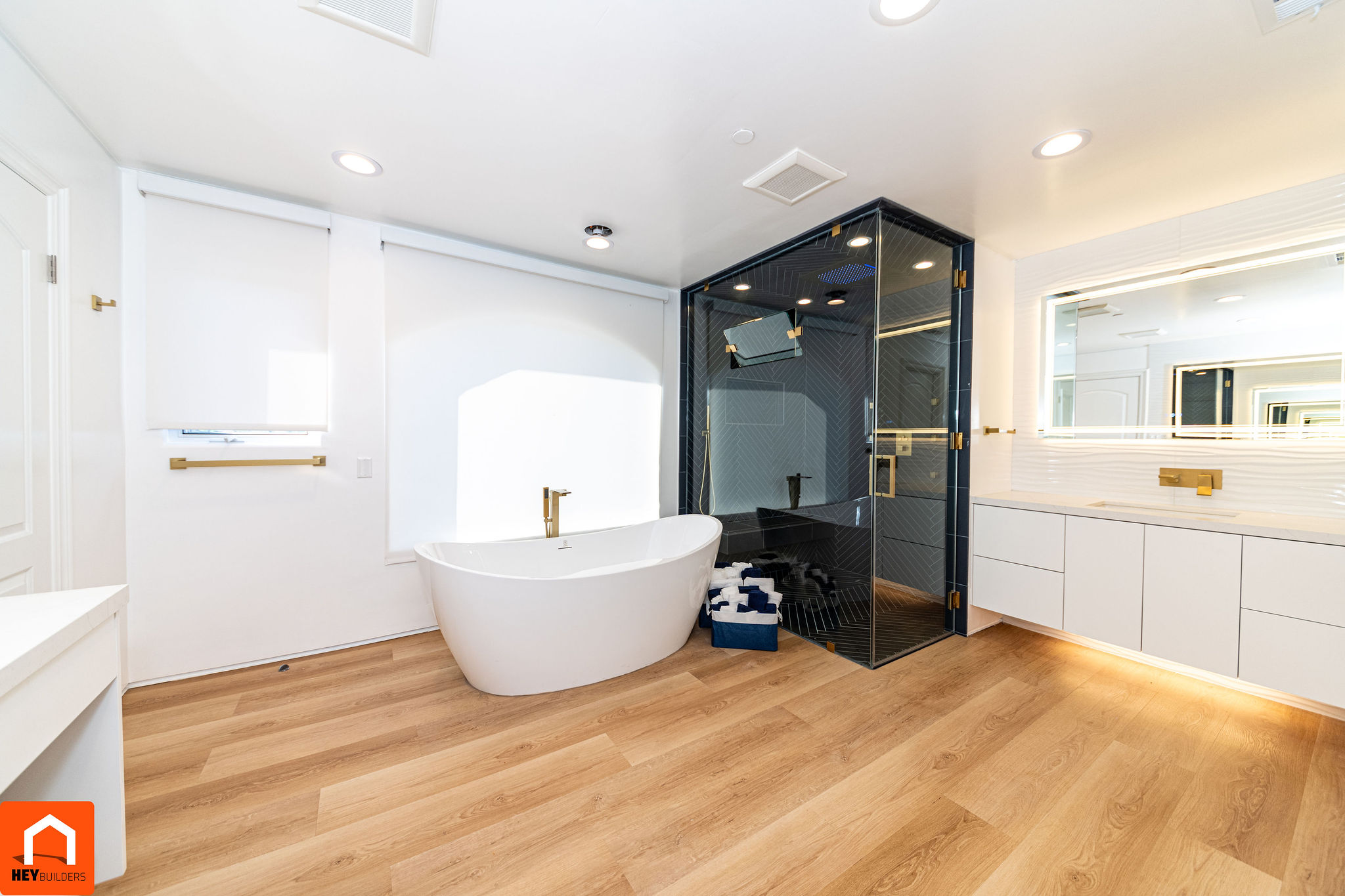
When Paul and Kat came to Hey Builders, they knew their Calabasas home had great bones — but the bathrooms hadn’t been updated in decades. Dated tile, cramped layouts, and worn fixtures were hiding the home’s true potential. Our team worked closely with Paul and Kat to transform three bathrooms into modern, spa-inspired retreats — all while staying on schedule and on budget. Here’s the full transformation. Master Bathroom: From Dated to Dream Spa The original master bathroom featured an enclosed corner jacuzzi tub, a cramped neo-angle shower with beige tile, and a basic vanity with outdated lighting. Functional, but far from the relaxing retreat this home deserved. Before: Dated vanity and corner jacuzzi tub Before: Enclosed shower with dated tile The transformation is dramatic. We replaced the enclosed tub with an elegant freestanding soaking tub and a brass floor-mount faucet. The cramped shower became a spacious walk-in with floor-to-ceiling dark herringbone tile, a rain showerhead, and a built-in bench. A floating vanity with a backlit LED mirror and wave-textured backsplash tile completed the spa-like feel. After: Freestanding soaking tub with brass fixtures After: Spacious walk-in shower with herringbone tile Powder Room: Small Space, Big Impact The original powder room had a decorative vessel sink on an ornate shell cabinet and a busy, dated aesthetic. The space felt cluttered and disconnected from the rest of the home. Before: Ornate vessel sink and dated cabinet Before: Small toilet closet The new powder room is a study in modern elegance. A sleek black floating vanity with dark marble countertop sits against a stunning textured wood-grain accent wall. The black-framed mirror and minimalist fixtures give the space a boutique hotel feel. After: Modern floating vanity with textured accent wall Secondary Bathroom: Clean and Contemporary The secondary bathroom had a dated tub-shower combo with a bold black stripe pattern, light blue walls, and mismatched fixtures. The space needed a cohesive design update. Before: Dated vanity with brass fixtures Before: Dated tub-shower combo Beyond the Bathrooms Paul and Kat’s renovation didn’t stop at the bathrooms. We also transformed their entry foyer with a stunning two-story cascading chandelier, glass stair railing, and dark fluted accent walls — plus a full master bedroom refresh and an upstairs sitting nook. See the complete project gallery here. Renovated entry with cascading chandelier Glass stair railing and fluted accent wall Ready to Transform Your Home? Every home has untapped potential. Whether you’re looking to update a single bathroom or reimagine your entire living space, Hey Builders brings the craftsmanship and vision to make it happen. Serving Calabasas, Beverly Hills, Bel Air, Encino, and all of Los Angeles. Schedule your free consultation and let’s talk about your project.

Choosing a general contractor in Los Angeles

Hiring a general contractor is one of the most consequential decisions you’ll make as a homeowner. In Los Angeles — where construction costs are high, permitting is complex, and the stakes are significant — choosing the wrong contractor can cost you hundreds of thousands of dollars, months of delays, and endless frustration. At Hey Builders Inc, based in Calabasas, we’ve seen firsthand what happens when homeowners hire the wrong contractor. We’ve also built our reputation on being the kind of contractor that LA homeowners trust with their most important projects — completing over 230 renovations and additions across Los Angeles County. Here’s how to find a contractor who will deliver quality work on time and on budget. Start With Licensing and Insurance This is non-negotiable. In California, any contractor performing work valued at $500 or more must hold a valid license from the Contractors State License Board (CSLB). Before you even schedule a consultation, verify the following: Active CSLB license: Check the contractor’s license status at cslb.ca.gov. Look for the correct classification — a Class B (General Building) license is required for most residential remodeling and additions. Workers’ compensation insurance: If the contractor has employees, they must carry workers’ comp. Without it, you could be liable if a worker is injured on your property. General liability insurance: This protects you if the contractor’s work causes damage to your property or a third party. Ask for a certificate of insurance and verify the coverage amount — $1 million minimum is standard for residential work in LA. Bond status: California requires licensed contractors to carry a contractor’s bond (currently $25,000). This provides a financial safety net if the contractor fails to fulfill their obligations. A contractor who hesitates to provide this documentation is a contractor you should avoid. Evaluate Experience With Your Type of Project Not all contractors are created equal, and not all experience is relevant. A contractor who specializes in commercial tenant improvements may not be the right fit for a luxury kitchen remodel in Brentwood. A contractor focused on tract home development may struggle with the complexities of a hillside addition in the Hollywood Hills. When evaluating a contractor’s experience, ask these questions: How many projects similar to mine have you completed? Look for a track record of at least 10 to 20 comparable projects. Can I see examples of your work in my neighborhood? A contractor familiar with your area understands local building codes, HOA requirements, and the architectural styles that define your community. Do you have experience with the Los Angeles Department of Building and Safety (LADBS)? Navigating LA’s permitting process requires specific expertise. Contractors who regularly work with LADBS know how to avoid common pitfalls that delay projects. What is the largest project you’ve managed? If you’re planning a $500,000+ renovation, you want a contractor who has successfully managed projects of that scale. Check References and Reviews — But Do It Right Online reviews on Google, Yelp, and Houzz provide a useful starting point, but they don’t tell the whole story. Here’s how to dig deeper: Ask for at least three recent references — and actually call them. Ask specific questions: Did the project come in on budget? If not, what changed and how was it communicated? Was the project completed on time? What caused any delays? How did the contractor handle unexpected issues or changes? Was the job site kept clean and organized? Would you hire this contractor again? Visit a completed project if possible. Photos look great in portfolios, but seeing the quality of workmanship in person — the precision of tile work, the finish of cabinetry, the attention to detail in trim and molding — tells you far more than a curated gallery. Check for complaints with the CSLB, Better Business Bureau, and local consumer protection agencies. A single complaint on a long track record may not be a dealbreaker, but a pattern of disputes is a clear red flag. Understand the Bidding Process For any significant renovation in Los Angeles, you should obtain detailed bids from at least three qualified contractors. Here’s what to look for — and what to watch out for: Detailed line-item estimates. A professional bid breaks down costs by category: demolition, framing, electrical, plumbing, HVAC, finishes, fixtures, permits, and contingency. Vague bids with lump-sum pricing make it impossible to compare contractors or understand where your money is going. Realistic timelines. Be skeptical of any contractor who promises to complete a major renovation significantly faster than the competition. Aggressive timelines often lead to cutting corners or subcontractor scheduling conflicts that create quality issues. The lowest bid isn’t always the best bid. In LA’s competitive construction market, a bid that’s 20% to 30% below the others usually means something is being left out — whether it’s permit costs, quality materials, experienced labor, or adequate project management. The cheapest option often becomes the most expensive when change orders and corrections pile up. Contingency allowance. A reputable contractor includes a contingency of 10% to 15% for unforeseen conditions, especially in older homes. Opening walls in a 1940s Hancock Park home or a 1960s ranch in Encino frequently reveals surprises — outdated wiring, hidden water damage, or non-code-compliant framing that must be addressed. Red Flags That Should Make You Walk Away In our years of serving LA homeowners, we’ve heard countless stories of contractor experiences gone wrong. Here are the warning signs that should prompt you to look elsewhere: Demands large upfront payments. California law limits down payments to $1,000 or 10% of the contract price, whichever is less. A contractor asking for 30% to 50% upfront is either undercapitalized or dishonest — both are dangerous. No written contract. Every detail should be documented: scope of work, payment schedule, timeline, change order process, warranty terms, and dispute resolution. Verbal agreements are unenforceable and leave you exposed. Pressures you to skip permits. Unpermitted work in Los Angeles creates serious legal and financial liability. It can void your homeowners insurance, create problems at resale, How to Choose a General Contractor in Los Angeles: A Homeowner’s Guide

Seismic retrofitting and foundation repair in Los Angeles

Los Angeles sits on some of the most active fault lines in the United States. The San Andreas Fault, the Hollywood Fault, the Newport-Inglewood Fault — they crisscross the region and pose a real, ongoing threat to residential properties. If you own a home in LA, seismic retrofitting isn’t just a smart investment — it may be a legal requirement. At Hey Builders Inc in Calabasas, we’ve helped homeowners across Los Angeles County strengthen their homes against earthquake damage. With over 230 completed projects and deep expertise in LA building codes, we understand what it takes to protect your most valuable asset. What Is Seismic Retrofitting? Seismic retrofitting involves strengthening an existing structure to make it more resistant to earthquake forces. For residential properties in Los Angeles, this typically includes one or more of the following: Foundation bolting: Securing the wooden frame of your home to its concrete foundation using anchor bolts and steel plates. This prevents the house from sliding off its foundation during shaking. Cripple wall bracing: Reinforcing the short wooden walls between the foundation and the first floor with structural plywood. Cripple walls are one of the most common failure points in older LA homes. Soft story retrofitting: Strengthening buildings with open ground floors — typically apartments or homes with tuck-under parking — by adding steel moment frames or plywood shear walls. Chimney bracing: Securing unreinforced masonry chimneys that can collapse during moderate to strong earthquakes. The goal is straightforward: keep your home standing, keep your family safe, and minimize the financial devastation that earthquake damage can cause. LA’s Mandatory Retrofit Ordinances The City of Los Angeles has enacted some of the most aggressive seismic retrofit mandates in the country. If you own property in LA, you need to be aware of these requirements: Ordinance 183893 (Soft Story Buildings): Passed in 2015, this ordinance requires owners of soft story wood-frame buildings (typically apartment buildings with ground-floor parking) to complete seismic retrofitting. The city identified approximately 13,500 buildings that require compliance, with deadlines that have been rolling out in phases. Ordinance 184081 (Non-Ductile Concrete Buildings): This ordinance targets older concrete buildings that lack the flexibility to withstand seismic forces. These structures, common in commercial and mixed-use areas throughout LA, are considered among the most dangerous building types in an earthquake. Even if your property isn’t subject to a mandatory ordinance, voluntary retrofitting is strongly recommended — especially for homes built before 1980. Older homes in neighborhoods like Hancock Park, Los Feliz, Pasadena, and the Hollywood Hills were often constructed without modern seismic standards. The Real Cost of Not Retrofitting Many LA homeowners underestimate the financial risk of earthquake damage. Consider these realities: Standard homeowners insurance does not cover earthquake damage. You need a separate earthquake insurance policy, and even then, deductibles are typically 10% to 20% of the dwelling coverage amount. On a $3 million home, that means you’re responsible for the first $300,000 to $600,000 in damage before insurance pays a cent. Earthquake damage can render a home uninhabitable. Foundation failure, structural collapse, and severe cracking can require months of repairs — or total demolition and rebuild. In premium neighborhoods like Calabasas, Beverly Hills, or Brentwood, reconstruction costs often exceed $500 per square foot. Property value impact is real. As seismic awareness grows among LA homebuyers — particularly at the luxury level — homes without retrofitting are increasingly viewed as liabilities. Disclosure requirements mean that buyers will know if your home lacks basic seismic upgrades. The cost of retrofitting is a fraction of the cost of earthquake damage. For most single-family homes in Los Angeles, a comprehensive seismic retrofit runs between $5,000 and $30,000 — depending on the home’s age, size, foundation type, and the scope of work required. What Does the Retrofitting Process Look Like? A typical residential seismic retrofit in Los Angeles follows this process: 1. Assessment and engineering. A licensed engineer evaluates your home’s existing structure, foundation, and potential vulnerabilities. This assessment determines the scope of work and engineering requirements. 2. Permit application. Seismic retrofitting requires permits from the Los Angeles Department of Building and Safety (LADBS) or your local jurisdiction. Your contractor should handle the entire permitting process. 3. Construction. For a standard bolt-and-brace retrofit on a single-family home, construction typically takes 1 to 3 weeks. Most of the work happens in the crawl space beneath the home, so disruption to your daily life is minimal. 4. Inspection and certification. After completion, the city inspector verifies that all work meets code requirements. You receive documentation certifying that your home has been seismically retrofitted — a valuable asset for insurance purposes and future resale. Seismic Retrofitting and Insurance Benefits Retrofitting your home can lead to meaningful savings on earthquake insurance premiums. The California Earthquake Authority (CEA) offers premium discounts of up to 25% for homes that have been properly retrofitted. Additionally, the CEA’s Earthquake Brace + Bolt (EBB) program provides qualifying homeowners with grants of up to $3,000 toward the cost of seismic retrofitting. Eligibility is based on your home’s age, location, and construction type. Many homes in older LA neighborhoods like Silver Lake, Echo Park, Eagle Rock, and the San Fernando Valley qualify. For high-value properties, the insurance savings alone can recoup the cost of retrofitting within a few years — all while providing the peace of mind that comes with knowing your home is prepared for the next big earthquake. Which Homes Need Retrofitting Most? While every home in Los Angeles faces some level of seismic risk, certain properties are especially vulnerable: Homes built before 1980: Pre-1980 construction often lacks the seismic detailing required by modern building codes. Homes on raised foundations: Properties with crawl spaces and cripple walls are more susceptible to foundation failure. Hillside homes: Properties in the Hollywood Hills, Pacific Palisades, Bel Air, and similar hillside areas face additional risks from slope instability and landslides triggered by earthquakes. Homes with unreinforced masonry: Brick chimneys, stone veneer, and unreinforced masonry walls are extremely vulnerable to seismic forces. Multi-story homes Seismic Retrofitting in Los Angeles: Why Every Homeowner Should Care

Second story home addition in Los Angeles

If you’re a homeowner in Los Angeles looking to expand your living space without sacrificing your yard, a second story addition is one of the smartest investments you can make. Whether you’re in Calabasas, Encino, Brentwood, or Pacific Palisades, building up instead of out lets you maximize your property’s potential while preserving the outdoor living that makes Southern California so desirable. At Hey Builders Inc, headquartered in Calabasas, we’ve completed over 230 residential projects across Los Angeles County — and second story additions remain one of our most requested services. Here’s everything you need to know before breaking ground. Why LA Homeowners Are Building Up Land in Los Angeles is at a premium. In neighborhoods like Studio City, Sherman Oaks, and Westlake Village, lot sizes often limit what you can build outward. A second story addition lets you double your square footage without reducing your outdoor space — no encroaching on setbacks, no losing your pool or garden. For affluent homeowners, the motivation often goes beyond simple space. A second story addition allows you to create: A private primary suite with panoramic views of the Santa Monica Mountains or city skyline Dedicated home office space separated from family living areas Additional bedrooms and bathrooms for growing families or frequent guests A rooftop deck or terrace for entertaining with views In a market where the median home price in premium LA neighborhoods exceeds $2 million, building up is almost always more cost-effective than buying a larger home. How Much Does a Second Story Addition Cost in Los Angeles? The cost of a second story addition in Los Angeles typically ranges from $350 to $600+ per square foot, depending on the scope, finishes, and structural requirements. For a 1,000-square-foot addition — enough for a primary suite, bathroom, and an extra bedroom — you’re looking at approximately $350,000 to $600,000 or more. Several factors influence the final price: Structural reinforcement: Your existing foundation and framing must support the new load. Older homes in areas like Hancock Park or Pasadena may require significant upgrades. Architectural design: Custom designs with vaulted ceilings, floor-to-ceiling windows, or cantilevered elements cost more but deliver dramatic results. Finish level: High-end materials like European white oak flooring, custom cabinetry, and designer fixtures push costs toward the higher end. Seismic compliance: Los Angeles building codes require earthquake-resistant construction, which adds engineering and material costs. Temporary relocation: Unlike a ground-floor remodel, a second story addition often requires you to vacate parts of your home during construction. Permits and Regulations in Los Angeles A second story addition in LA is a major structural project that requires multiple permits and approvals. Here’s what you need to navigate: Building permits from the Los Angeles Department of Building and Safety (LADBS) are mandatory. The process includes plan check review, structural engineering approval, and multiple inspections throughout construction. Zoning compliance is critical. Your property must conform to height restrictions, setback requirements, and floor area ratio (FAR) limits for your zone. In hillside areas like the Hollywood Hills or Bel Air, additional regulations and environmental reviews may apply. Homeowners association (HOA) approval may be required in communities like Hidden Hills, Calabasas, or gated neighborhoods in Brentwood. HOA architectural review can add weeks to your timeline, so start early. Working with an experienced general contractor who understands LA’s permitting process is essential. At Hey Builders, we handle all permit applications, plan submissions, and inspections on behalf of our clients — so you don’t have to navigate the bureaucracy yourself. The Construction Timeline A typical second story addition in Los Angeles takes 6 to 12 months from permit approval to completion. Here’s a general breakdown: Design and engineering: 4–8 weeks Permitting: 6–12 weeks (varies by jurisdiction and project complexity) Foundation and structural reinforcement: 3–4 weeks Framing: 4–6 weeks Mechanical, electrical, and plumbing (MEP): 3–4 weeks Interior finishes: 6–8 weeks Final inspections and punch list: 2–3 weeks Weather rarely causes significant delays in LA, which is one advantage of building in Southern California. However, supply chain issues for specialty materials — imported tile, custom steel work, or European fixtures — can extend timelines if not planned for in advance. Return on Investment: Is It Worth It? A well-executed second story addition in Los Angeles delivers one of the highest returns of any home improvement project. According to industry data, homeowners can expect to recoup 60% to 75% of their investment at resale — and in high-demand LA neighborhoods, the figure can be even higher. But ROI isn’t just about resale value. Consider the lifestyle return: You avoid the cost and stress of moving (realtor commissions, transfer taxes, and closing costs in LA can easily exceed $150,000 on a $2M+ home) You stay in your preferred neighborhood and school district You get a home customized to your exact specifications You add square footage in a market where price per square foot continues to climb For homeowners in Calabasas, Woodland Hills, Tarzana, and similar areas, a second story addition often makes more financial sense than competing in an overheated market for a larger home. Design Tips for Your Second Story Addition When planning a second story addition in Los Angeles, keep these design principles in mind: Match the architectural style. Your addition should look like it was always part of the home. Whether your house is Mid-Century Modern, Spanish Revival, or Contemporary, the second floor should integrate seamlessly. Maximize natural light. LA’s climate is one of its greatest assets. Large windows, skylights, and glass doors bring in natural light and connect interior spaces to the outdoors. Plan for views. If your property has mountain, canyon, or city views, orient the primary suite and living spaces to take full advantage. Even partial views can significantly increase property value. Include outdoor space. A balcony, terrace, or roof deck extends your living area and is one of the most desirable features for LA homebuyers. Think about energy efficiency. New construction gives you the opportunity to install high-performance windows, upgraded insulation, and energy-efficient HVAC systems that Second Story Addition in Los Angeles: Everything You Need to Know

Room Addition Permit Requirements in Los Angeles: What Homeowners Need to Know (2026) Adding a room to your home is one of the most impactful upgrades you can make — more living space, increased property value, and a home that finally fits your family’s needs. But before the first wall goes up, there’s a critical step every Los Angeles homeowner must navigate: the permitting process. Understanding room addition permit Los Angeles requirements can save you thousands of dollars, months of delays, and serious legal headaches down the road. At Hey Builders Inc, we’ve guided homeowners through over 230 room addition and remodeling projects across Los Angeles. Here’s everything you need to know about permits for your room addition in 2026. When Do You Need a Room Addition Permit in Los Angeles? The short answer: almost always. The City of Los Angeles Department of Building and Safety (LADBS) requires a building permit for any construction that adds square footage to your home. This includes: Bedroom additions Bathroom additions Family room or living room extensions Second-story additions Garage conversions (converting to livable space) Accessory Dwelling Units (ADUs) Even if the addition seems small — say, bumping out a wall by a few feet — you likely need a permit if the project changes the footprint or structural elements of your home. The only exceptions are minor cosmetic work like painting or replacing flooring, which don’t alter the building’s structure. Skipping the permit might seem tempting to save time and money, but unpermitted work can result in fines up to $25,000 or more, forced demolition of completed work, and major complications when you try to sell your home. Los Angeles is particularly strict about enforcement, so it’s never worth the risk. What Permits and Approvals Are Required? A room addition permit in Los Angeles typically involves multiple layers of approval. Depending on the scope of your project, you may need: Building Permit — Required for all structural work, including framing, foundation, and roofing changes. Electrical Permit — Needed if you’re adding outlets, lighting, or running new circuits. Plumbing Permit — Required for any new plumbing lines, fixtures, or drainage work (especially bathroom additions). Mechanical Permit — Covers HVAC ductwork, ventilation, and heating systems for the new space. Grading Permit — May be required if excavation or site grading is needed, particularly on hillside properties. Zoning Clearance — Ensures your addition complies with local zoning laws, including setback requirements, lot coverage limits, and height restrictions. For properties in specific zones or historic overlay districts, additional reviews from the Department of City Planning may be necessary. Homeowners in hillside areas should also expect geotechnical and soils reports as part of the approval process. The Los Angeles Room Addition Permit Process: Step by Step Here’s what the typical permitting process looks like for a room addition in Los Angeles in 2026: Architectural Plans and Engineering — A licensed architect or designer creates detailed construction drawings that meet LA building codes. Structural engineering calculations are also required. Plan Check Submission — Plans are submitted to LADBS for review. You can submit online through the LADBS online portal or in person. Digital submissions have become the standard and tend to move faster. Plan Check Review — LADBS reviewers examine your plans for compliance with the California Building Code, local zoning ordinances, fire safety requirements, energy code (Title 24), and accessibility standards. Corrections and Resubmission — It’s common to receive correction letters. Your architect addresses the comments and resubmits. This back-and-forth can happen one to three times. Permit Issuance — Once plans are approved, you pay the permit fees and receive your building permit. Construction can officially begin. Inspections During Construction — LADBS inspectors visit the site at key milestones: foundation, framing, electrical rough-in, plumbing rough-in, insulation, and final inspection. Final Sign-Off — After passing the final inspection, you receive a Certificate of Occupancy or final approval, confirming the addition is safe and code-compliant. How Much Does a Room Addition Permit Cost in Los Angeles? Permit costs for a room addition in Los Angeles vary based on the project’s valuation, square footage, and complexity. As of 2026, here’s a general breakdown: Building permit fees: Typically range from $2,500 to $15,000 depending on project size and valuation. Plan check fees: Usually 60–80% of the building permit fee. School fees: Assessed by the local school district, typically $4.00–$5.00 per square foot of new construction. Energy compliance fees: A few hundred dollars for Title 24 energy compliance review. Other fees: May include sewer connection, park dedication, and green building fees depending on your area. For a typical 400-square-foot room addition, total permit and fee costs often land between $8,000 and $20,000. While that’s a significant expense, remember that these permits protect your investment and ensure the work is done safely and to code. How Long Does the Permit Process Take? Timeline is one of the biggest questions homeowners ask. In Los Angeles, you should plan for the following: Plan preparation: 2–4 weeks for architectural drawings and engineering. Initial plan check review: 4–8 weeks at LADBS (can vary based on current backlog). Corrections and resubmission: 2–6 weeks per round of corrections. Permit issuance: 1–2 weeks after final approval. In total, expect the permitting process to take anywhere from 2 to 5 months before construction begins. Expedited plan check services are available through LADBS for an additional fee and can significantly reduce wait times. Common Mistakes Homeowners Make with Room Addition Permits After completing hundreds of projects in Los Angeles, we’ve seen homeowners stumble on the same issues repeatedly. Here are the most common mistakes to avoid: Starting work without a permit. This is the number one mistake. Even “minor” structural work needs approval. Getting caught means stop-work orders, fines, and potentially tearing out completed work. Not checking zoning restrictions first. Your lot may have setback requirements, height limits, or lot coverage maximums that limit what you can build. Always verify zoning before designing your addition. Hiring unlicensed contractors. An unlicensed contractor may Room Addition Permit Requirements in Los Angeles: What Homeowners Need to Know (2026)